

A pest control inspection checklist tells a technician what to look for on the way in. Very few say anything about the way out.
Inspection is the visible craft of the job, so it collects the training hours, the certification questions, and nearly all of the writing. Close-out gets learned by watching whoever you rode with in your first month, and it shows up nowhere on a route sheet. A branch manager can quote average service time to the minute and has no number at all for what happens after the last application goes down.
Below is the full checklist, both halves of it, plus a fillable version for the truck. The sections after it stay with the close-out, which is the half that determines how well the visit holds up.
What You Get Here
- The full 22-check close-out list, plus three templates to make your own
- The four ways a rushed close-out costs you money
- The one record field that makes everything else unverifiable
- The sentence that prevents a day-three phone call
- When the NPMA-33 is not the form your state accepts
- Three templates to download, edit, and keep as your own
What Should A Pest Control Inspection Checklist Cover From Arrival To Departure?
The list runs twenty-two checks across five blocks. Arrival and walkthrough are compressed on purpose, since those steps are documented well elsewhere and most technicians already run them competently.
If this list looks close to how your crew already works, we put it into a form you can actually use. Add the checks your accounts need, drop the ones they don’t, and make it yours. We hope it saves you a callback or two. → Download the pest control inspection checklist
The last three blocks are where the money is, and they are the ones that get compressed when a technician is running forty minutes behind on a Friday.
Where Do Pest Control Callbacks Come From?
Nobody schedules the close-out. A route gets built around drive time and service time, so verification after treatment gets whatever minutes are left over, and when a job runs long, the same part always absorbs the delay.
Four shortcuts come out of that compression, and each one runs as a chain.
| The shortcut | What it costs | Who raises it, and when |
|---|---|---|
| Zone treated but never verified | An unbilled return trip, plus the rest of that day’s route absorbing it | The customer, around day four |
| Findings given verbally at the door | A disputed invoice, with nothing written to settle what was promised | The customer, at billing |
| Information collected but never entered | An audit finding on work that was performed correctly | A third-party auditor, weeks later |
| Application record left incomplete | A licensing problem, not a service one | A state inspector, months later |
The second row compounds quietly. A service record written on site is what settles a billing dispute, which is why close-out discipline shows up in collections before it shows up in service quality. Close-out records are what your invoicing and billing software has to work with, and a company that struggles to defend a line item usually has a documentation problem before it has a billing one.
Which Zone Is Most Likely To Get Missed?
Verification runs in the opposite direction from inspection. An inspection moves inward from the property line. A close-out moves outward from the last room you worked in, so the zone most likely to get skipped is the one you treated first and filed as finished an hour ago. Re-check it before you leave the building, since it has had the longest dwell time of anything you applied, and early behavior there is something you can watch, not predict.

Then confirm every zone on the work order was actually reached. A locked utility room, a crawl space blocked by stored boxes, and a tenant who would not open a door all look identical on paper unless someone writes down what happened. An untreated zone is a service gap. An untreated zone nobody recorded is a liability, because six weeks later nothing distinguishes a technician who could not get in from one who did not try.
Devices go back where the map says they go. Convenience placement during a visit is normal and forgivable. Leaving them there is what turns a clean account into an audit finding.
Last, confirm the pest control methods you applied fit what you actually saw. Work orders get written from a phone call, and the phone call is frequently wrong about the species.
Where Should A Technician Write The Service Record?
A service record composed in the driveway is a different document from one composed where the finding is. Location, evidence type, measurement, and product all blur within minutes of leaving the space, and what survives is a summary. Summaries no longer clear the bar. Pest Control Technology has made the point that a service order now carries the who, what, where, when, and why of a visit, and the standard applies to a residential account as much as to a food plant.
An application record needs eight fields.
- Product name
- EPA registration number
- Rate and quantity applied
- Target pest
- Treated location
- Applicator
- Date and time
- Re-entry interval
Miss one and the record is incomplete, which is the only category that matters during an inspection. Re-entry intervals count even when you said them out loud, because nobody can retrieve what you said. Photos work the same way. One taken at the finding shows the finding. One taken afterward shows a wall.
What Should You Tell The Customer Before You Leave?
Most post-treatment callbacks are not treatment failures. Many applications drive pests out of harborage before they take effect, which produces a visible increase in activity for several days. A customer who was not warned reads that as a failed service and picks up the phone. A customer who was warned reads it as the product working.
Four items belong in the customer’s copy.
- What you found and what you applied, in plain language they can read back to a spouse or a facility manager who was not present
- What they are responsible for, phrased as specific tasks with timing attached
- Re-entry timing for people and pets, stated as a clock time
- The next service date, confirmed on site and never left as a promise to dispatch
The written copy is a federal obligation on restricted-use work, not a courtesy. USDA’s Agricultural Marketing Service states that commercial applicators, agricultural and non-agricultural alike, must furnish the required record data to the person the application was made for.
All of it lands in the account record too, which is where a CRM for pest control technicians earns its keep. Whoever takes the next visit inherits the conversation and does not restart it.
What Should A Technician Restock At The End Of A Route?
Vehicle checks appear on almost no inspection checklist, which is strange given that the truck decides how the next day’s first job goes. Restock against the route ahead, not against what ran out, because those are two different lists and only one of them prevents a mid-morning supply run.
Equipment decontamination between accounts matters most on bed bug work, where skipping the step transfers the problem to the next customer and creates a callback that has nothing to do with the treatment you performed.
Chemicals get secured and containers sealed for transport. Used devices and waste leave with you, disposed of according to label and local rules, because leaving them behind happens more than most operations managers realize.

What Changes On A Commercial Pest Control Account?
Residential close-outs end with a person. Commercial close-outs end with a record a third party reads months later without you there to explain it, so the exit adds five steps that belong on any pest control audit checklist.
| What commercial adds | Why it matters |
|---|---|
| Logbook entry completed on site | Verbal recommendations to a floor supervisor do not survive an audit, and frequently do not survive the week |
| Device scan data captured | One visit shows what is present; a sequence of visits shows if the account is improving |
| Site map updated the moment a device moves | Map-to-placement mismatches are among the most common findings on otherwise well-run accounts |
| Facility contact signature and a named recipient | An unaddressed recommendation belongs to nobody |
| License, safety data sheets, and product labels accessible | Facilities under FSMA and the GFSI schemes are audited on availability, and technicians assume the branch handled it |
What Should A Pest Control Report Template Include?
Everything verified in the sections above lands in one of two documents. The report is what leaves with the customer. The log is what stays with the account.
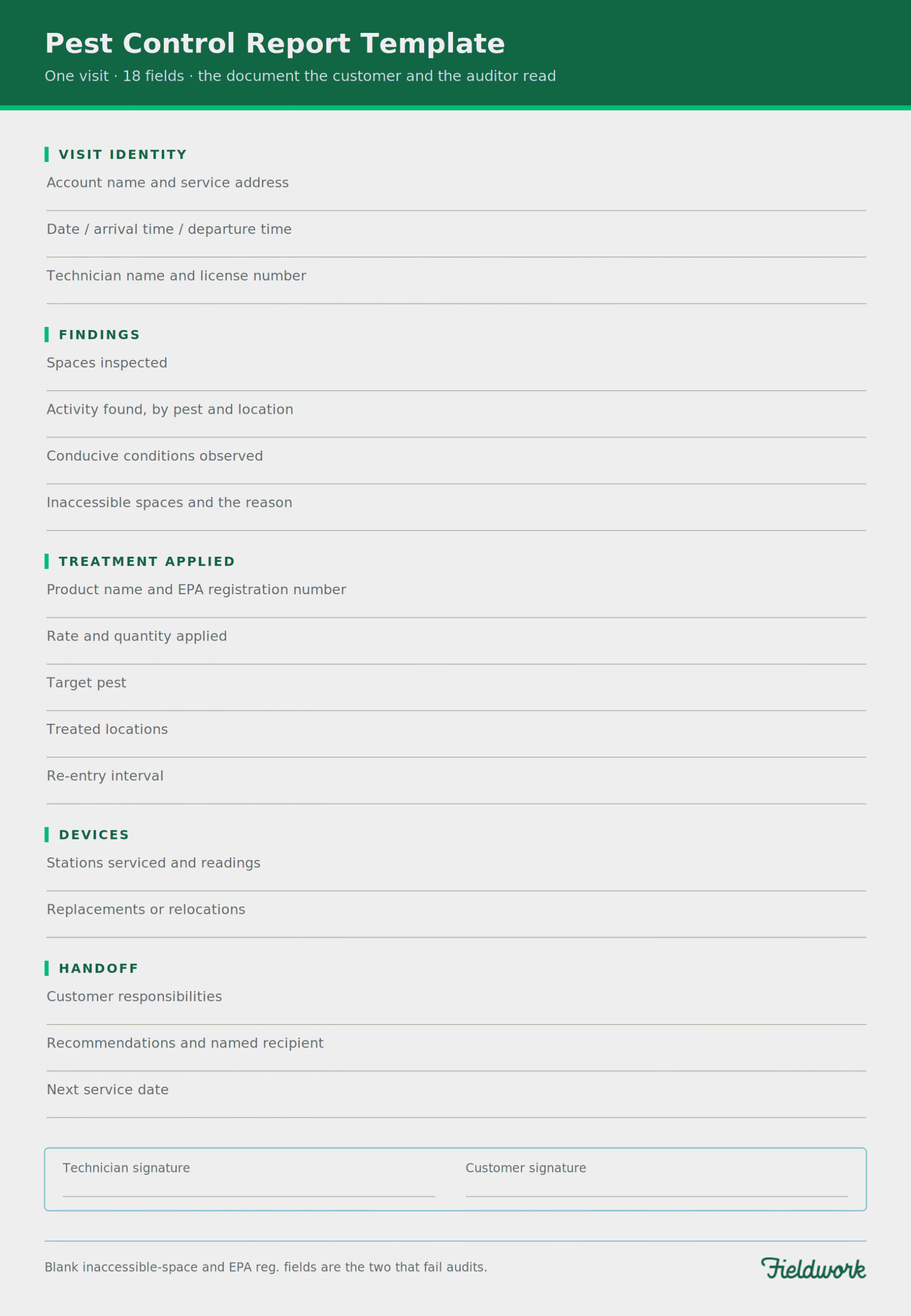
A pest control report template covers a single visit and needs roughly eighteen fields across five groups.
- Visit identity
- Findings
- Treatment applied
- Devices
- Handoff
Like the layout? We built it into a form your techs can fill out on site. Every field is editable, so add whatever your state asks for, take out what you never use, and shape it around the way you already write up a visit. We hope it gets the paperwork finished before you pull out of the driveway. → Download the pest control report template
Two of those fields carry more weight than their size suggests. The EPA registration number identifies the exact formulation, so a product name alone cannot verify what was applied. The signature turns the document from a claim into a record.
Why Do You Need A Pest Control Log Template As Well As A Report?
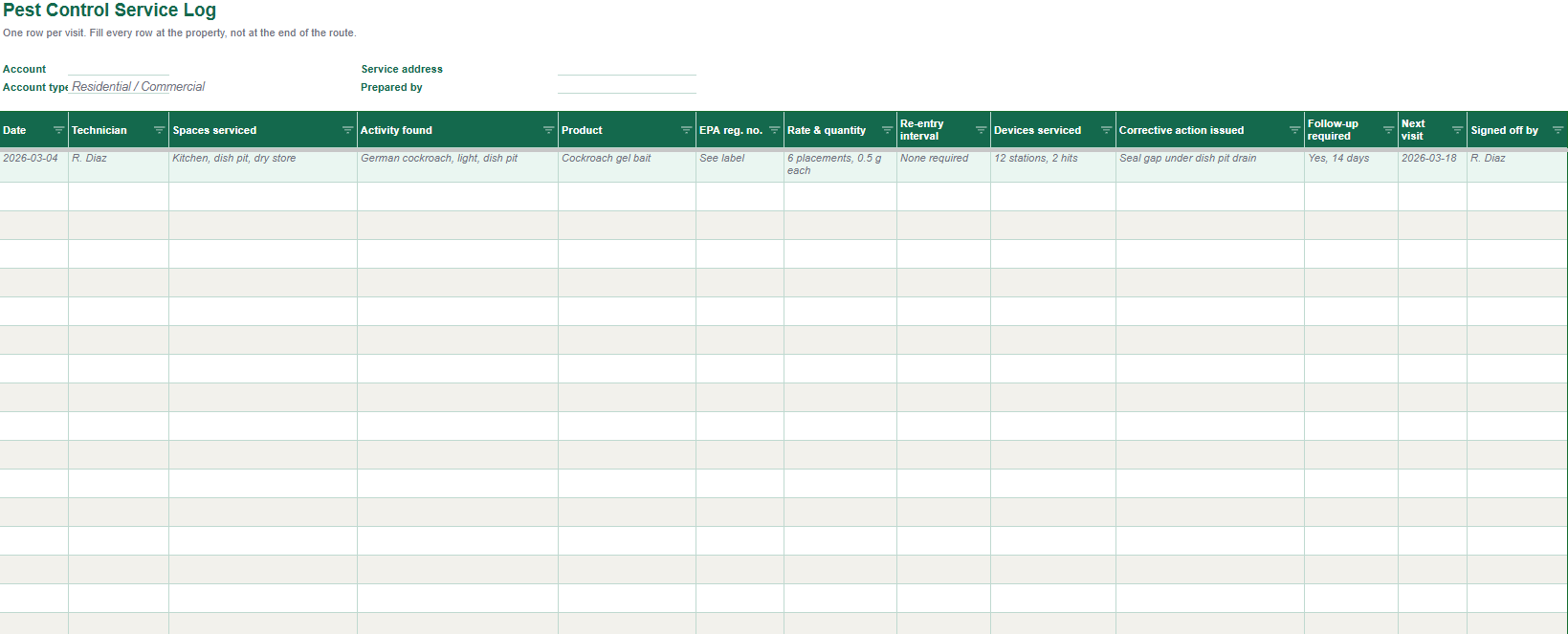
A pest control log template runs across visits, structured as a table where each row is a service date. Columns cover date, technician, spaces serviced, activity found, product, EPA registration number, rate and quantity, re-entry interval, devices serviced, corrective actions issued, follow-up required, next visit, and signed off by.
If you like this template, we’ve prepared a convenient form for you that you can use: fill in the fields, add or remove them, and customize it as you see fit. We hope it comes in very handy in your work! → Download the pest control log template
A single report cannot show a trend. It can tell you German cockroaches were found near a dish pit, and four consecutive reports can tell you the same fact four times without anyone noticing, because each gets read in isolation. Recurring activity in one zone across three visits points at a structural or sanitation cause that treatment will not resolve, and activity moving between three zones points at something else entirely. Only the log separates the two.
On commercial accounts, the log is the first document an auditor opens. A gap in it suggests the program was not running, which carries more weight than a thin report suggesting one weak visit.
How Do You Make A Close-Out Impossible To Skip?
The person verifying a paper checklist is the same person trying to leave, and no clipboard has ever stopped anyone from ticking a box on the way to the truck. A job that cannot be marked complete until required fields carry values and required photos exist moves that verification off the technician’s memory and into the workflow.
Three capabilities carry most of the weight. Required fields and photo capture turn the close-out into a gate. Offline capture matters because crawl spaces and basements are where signal is worst, and findings carry the most consequence. Same-day office visibility gets a corrective action to a manager before the route ends.
One entry can produce both documents, removing the duplicate work that makes technicians resent documentation. Field service software built for pest control generates the report the customer receives and appends the same data to the running log.
Whose Problem Is Close-Out Quality?
Close-out quality is a management problem before it is a technician problem. Nobody trains it, nobody times it, and nobody reviews it, so it degrades quietly in every branch until a callback rate or an audit finding makes it visible. Deciding what a finished job looks like, and where that gets recorded, is the part only the office can do.
FAQ
How long do we have to keep pesticide application records?
The federal two-year floor under FIFRA covers restricted-use products only, which is a smaller share of residential work than most technicians assume. General-use products fall to state law entirely. Some states close the gap themselves, and Texas requires two years on every application regardless of classification. Confirm yours with your state lead agency.
Who keeps the log on a commercial account, us or the customer?
Both, which is where records go missing. The on-site logbook belongs to the facility and is what the auditor reads, and the company holds the master copy. Name one of them as authoritative in the service agreement, and the audit-day argument disappears.
What if the customer is not home at the end of the job?
Leave the written findings and prep instructions in an agreed location, then send the same information through whatever channel the account uses. The next service date becomes a dispatch task, so flag it in the record and never assume it. An unconfirmed next visit is the most common way a recurring account lapses.
How many photos is enough on a routine visit?
Count by finding. Each documented finding needs one photo showing the evidence and enough surrounding space to place it. Six findings, six photos. No findings, none. Per-visit quotas just get you photographs of nothing in particular.
Can one checklist cover residential and commercial accounts?
One pest inspection checklist with a commercial extension beats two separate lists, since the first four blocks are identical and technicians moving between account types will not reliably switch documents. The extension adds the logbook entry, device scan data, site map update, and facility contact signature.
Make Every Pest Control Inspection Count
Keep inspection findings, treatment records, and service history organized in one place. Fieldwork helps your team document every visit, track follow-ups, and spend less time on paperwork.
Field Service Management Blog
Tagged in
